


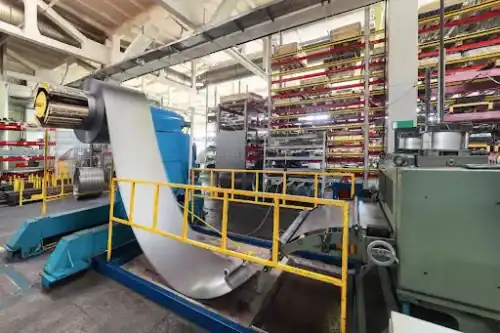
 When engineers specify aluminum components, extrusion is often the default, but aluminum roll forming offers a more efficient alternative for many profile designs. The process supports continuous production, in-line secondary operations, and long part lengths without the billet limitations associated with extrusion.
For applications requiring punched features, tight repeatability, and moderate-to-high production volumes, aluminum roll forming can reduce total cost and simplify downstream fabrication.
Premier Products of Racine provides custom aluminum roll forming with in-house tooling and integrated secondary operations. We work directly with engineering teams to produce repeatable, tight-tolerance profiles for applications ranging from appliance components to structural assemblies.
Custom Aluminum Roll Forming Capabilities
Our equipment handles material from 0.020 in. to 0.250 in. thick, with formed width capacity up to 12 in. We hold tolerances of ±0.010 in. on hole placement and ±1/32 in. on overall dimensions, depending on part geometry and material selection. Our aluminum roll forming capabilities support a range of material thicknesses and dimensional requirements:
- 3003-H14 aluminum
- 5052-H32 aluminum
- 6061-T6 and 6061-O aluminum
- 6063 aluminum
We integrate secondary operations directly into the forming process to reduce handling and improve consistency:
- Pre-punching and piercing
- Notching and lancing
- Precision cut-to-length
- Embossing and marking
We run both aluminum and steel on the same production floor. For assemblies that combine roll-formed aluminum profiles with steel components, this allows you to consolidate suppliers, maintain consistent quality standards, and streamline delivery schedules.
Industries Served
We produce roll-formed aluminum profiles for applications requiring consistent geometry, corrosion resistance, and efficient assembly. These include appliance components, telecommunications enclosures, and medical device structures where dimensional repeatability is critical.
Additional applications include solar panel mounting systems, aerospace and defense components, automotive assemblies, and construction products, where long lengths and integrated features improve installation efficiency and reduce secondary operations.
Aluminum Roll Forming vs Extrusion: The Real-World Comparison
Engineers often default to extrusion without evaluating alternative forming methods. The comparison below outlines key differences between aluminum roll forming and extrusion in terms of production, cost, and design flexibility.
| Factor | Aluminum Roll Forming | Aluminum Extrusion |
| Production Speed | Continuous process, 30–150 ft./min. | Limited by billet length, requires aging |
| Length Limits | Unlimited (coil-fed) | Restricted by press capacity (typically 20–40 ft.) |
| In-Line Operations | Punching, notching, and cut-to-length in a single pass | Requires secondary operations post-aging |
| Material Flexibility | Supports aluminum and other formable metals on shared equipment | Aluminum-specific |
| Volume Economics | Cost-effective at moderate to high production volumes | Extrusion may be preferred for low volume or highly complex closed profiles |
Roll forming is most effective when the part geometry does not require complex internal cavities or thick-walled closed sections, typically produced by extrusion. For designs requiring punched features, notches, or precise cut lengths, custom aluminum roll forming combines forming and fabrication into a single continuous process.
Selecting the Right Aluminum Alloy for Roll Forming
Alloy selection directly impacts formability, surface quality, and long-term performance of roll-formed aluminum profiles.
- 3003-H14 aluminum. Moderate strength, excellent formability, and corrosion resistance. Suitable for tight radii and complex profiles in appliance components, architectural trim, and food equipment.
- 5052-H32 aluminum. Higher strength than 3003 with superior corrosion resistance, particularly in marine or outdoor environments. Commonly used for enclosures, tanks, and structural components requiring durability.
- 6061-T6 aluminum. High-strength alloy with mechanical properties comparable to mild steel. However, limited ductility increases the risk of cracking at tight bend radii. For complex profiles, we recommend forming in the annealed (O) condition and aging post-forming, or selecting a more formable alloy such as 5052.
- 6063 aluminum. Commonly used for architectural applications and anodized components due to its ability to produce uniform, high-quality surface finishes.
Avoid 6061-T6 at Tight Radii
At bend radii below approximately three times material thickness, 6061-T6 is prone to cracking. When tight radii are required, we either form in the annealed condition (6061-O) and heat-treat after forming, or we recommend alternative alloys such as 5052-H32.
Anodizing Alloy Guidance
For anodized applications, 5052 and 6063 provide consistent, uniform finishes. 3003 is generally avoided due to its manganese content, which can cause color variation.
Preventing Surface Damage in Aluminum Roll Forming
Surface quality is a primary concern for aluminum components, particularly in cosmetic applications.
- Controlled material handling to prevent scratches
- Roll surface finishes and coatings
- Optimized forming sequences to reduce marking
- Protective films when require
Why Premier Products for Aluminum Roll Forming

Domestic manufacturing.
All production runs in Racine, Wisconsin. You work directly with our engineering team - no offshore communication delays.

Design-to-production partnership.
We identify forming risks - tight radii in 6061-T6, complex hole patterns near bends, or tight dimensional tolerances - during the quote stage. If roll forming is an aluminum extrusion alternative for your application, we'll show you the cost and lead-time advantages.

Aluminum handling experience.
Aluminum handling expertise. Proper material support, roll design, and forming sequences minimize surface marking and control springback variation across production runs.

Quality documentation.
We maintain documented quality procedures and inspection protocols, including first-article inspection reports and in-process dimensional checks.
Submit your part drawings or specifications, and our engineering team will evaluate your design, recommend the appropriate alloy, and determine whether roll forming is the right alternative to extrusion. Request a quote to get started on your aluminum roll forming project.


