


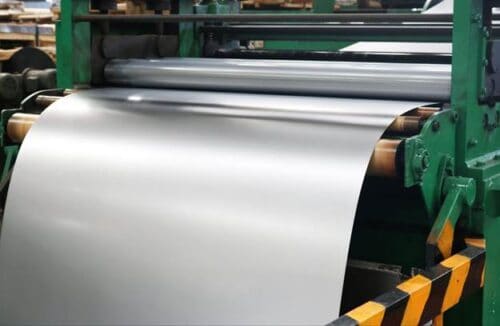
 Stainless steel roll forming produces continuous, high-precision profiles with consistent surface quality and tight dimensional control. The process incrementally forms coil-fed material at room temperature, enabling long lengths and complex cross-sections without the secondary finishing often required in other forming methods.
For engineers and procurement teams, this translates to repeatable tolerances, reduced scrap, and improved surface integrity on cosmetic parts.
Premier Products of Racine specializes in stainless steel roll forming for cosmetic and tight-tolerance applications. We process 201, 201 LN, 2204 duplex, 304, 304L, 316L, 430, and 439 grades using proprietary surface protection methods that minimize galling, roller marks, and scratching during forming.
Stainless Steel Roll Forming Grades: Application Guide
Selecting the correct stainless steel grade impacts corrosion resistance, formability, and overall part cost. The table below provides a quick comparison of commonly specified grades for roll forming applications.
| Grade | Primary Applications | Corrosion Resistance | Formability | Relative Cost |
| 304 | Appliance trim, handles, vanes (304 stainless roll forming) | Good general-purpose | Excellent | Baseline |
| 316L | Food processing, medical, and marine | Superior chloride resistance | Good | ~40% premium |
| 430 | Appliance trim, non-magnetic parts | Moderate (ferritic) | Good | ~20% savings |
| 201 | Appliance trim, tanker beams, structural | Moderate (low nickel) | Good | ~15% savings |
- 304 stainless steel. General-purpose grade for appliance components and food contact surfaces. 304 stainless roll forming delivers excellent formability and corrosion resistance for indoor and moderate outdoor environments.
- 316L stainless steel. Specified for food processing, pharmaceutical, medical, and marine applications. Molybdenum content provides superior chloride resistance for saltwater exposure and chemical cleaning.
- 430 stainless steel. Ferritic grade with no nickel. Magnetic, lower-cost, and suitable for indoor or mildly corrosive environments, such as appliance trim.
- 201 stainless steel. Lower-nickel alternative to 304 for high-volume structural applications, such as tanker components, where cost control and strength are key considerations.
Stainless Steel Roll Forming Challenges – And How We Solve Them
Stainless steel behaves differently from carbon steel during forming, introducing challenges that directly impact part quality, tolerances, and production cost. Understanding how these factors are managed is critical when evaluating a roll forming supplier. Stainless steel requires 60% more forming force than mild steel and introduces three critical challenges that affect roll-formed stainless steel profiles:
- Galling prevention. We can mitigate or eliminate if needed galling or surface defects during the roll forming process by employing any of the following techniques: extreme-pressure lubricants, polished roll surfaces, roll coatings and side roll stands. This significantly reduces surface damage and minimizes downstream rework.
- Springback compensation. Stainless steel exhibits a springback factor of ~3.5x compared to mild steel. We compensate through iterative tooling design – adding 50% more forming passes than mild steel requires. This delivers stainless steel roll forming tolerances as tight as ±0.008 in. on critical dimensions, depending on profile geometry and material selection.”
- Surface protection during forming. Scratches and roller marks are unacceptable on cosmetic stainless parts. Our proprietary process uses protective film application, custom roll coatings, and material-specific forming sequences. We have achieved surface quality standards, with a maximum of 2 defects ≤0.020 in. along the full length of appliance trim components.
Custom Stainless Steel Roll Forming Capabilities
Our stainless steel roll forming capabilities support a wide range of material specifications and production requirements:
Material specifications:
- Thickness: 0.010 in. to 3/16 in.
- Stainless steel roll forming tolerances: ±0.008 in. on critical dimensions
- Length: 1 ft. to 25 ft. continuous (coil-fed, unlimited)
- Grades: 201, 201 LN, 304, 304L, 316L, 430, 439
Available finishes:
- 2B mill finish (Ra 0.3–0.5 µm)
- BA bright annealed (mirror)
- No. 4 brushed directional (Ra 0.4–0.8 µm)
- No. 8 mirror polish
In-line operations:
- Pre-notching before forming
- Lock-seam forming for tube profiles
- Precision cut-to-length
- Edge conditioning
Design Considerations for Stainless Steel Roll Forming
Designing for stainless steel roll forming requires accounting for material behavior during deformation, particularly for austenitic grades.
- Springback compensation requirements (up to ~3.5x vs. mild steel)
- Bend radii vs. thickness limitations
- Pre-punching vs. post-forming operations
- Surface finish protection requirements
- Work hardening effects during forming
Industries We Serve
We produce roll-formed stainless steel profiles for applications where surface finish, dimensional consistency, and repeatability are critical. These include appliance components such as handles, trims, and door panels; food-processing and commercial-kitchen equipment requiring corrosion resistance and cleanability; and pharmaceutical and medical devices where material performance and finish standards are tightly controlled.
Additional applications include BBQ and outdoor cooking components, architectural trim, liquid-hauling tanker-truck structures, and telecommunications infrastructure, where long, consistent profiles support both structural integrity and assembly efficiency.
Why Premier Products for Stainless Steel Roll Forming

Proprietary surface protection
We address common stainless forming challenges such as galling, scratching, and roller marking through controlled tooling, lubrication, and process design.

Tight tolerance capability
We maintain consistent dimensional control on complex stainless profiles through advanced springback compensation and tooling

Domestic manufacturing
All production runs in Racine, Wisconsin. You work directly with our engineering team.

Design-to-production partnership
We identify forming risks - such as tight radii, pre-notching requirements, and finish constraints - early in the quoting and design phase.
Submit your part drawings or specifications, and our engineering team will review your design, recommend the appropriate stainless grade, and provide a detailed quote based on your production volumes. Request a quote to get started on your stainless steel roll forming project.


